

Enterprise Ethereum in 2026: Architecture, Use Cases, and the Future of Web3 Infrastructure
Last Updated on: March 9, 2026

The Ethereum Blockchain Platform remains the leading choice for enterprise Web3 adoption in 2026 due to its security, smart contract flexibility, tokenization capabilities, and strong Layer-2 ecosystem. Businesses benefit from transparent operations, reduced intermediaries, and new revenue models. This guide explains how Ethereum works in 2026, enterprise use cases, challenges, and why Ethereum continues to lead in the era of AI-powered blockchain analytics.
As businesses explore blockchain to improve transparency, automate workflows, and create new digital asset models, the Ethereum blockchain platform continues to dominate enterprise Web3 strategies. With advancements in scalability, Layer-2 rollups, security upgrades and AI in blockchain analytics, 2026marks a turning point for enterprise adoption.
This blog explains how Ethereum works in 2026, why it still leads the industry, and the most relevant Ethereum use cases for enterprises as organizations shift from pilots to real-world deployments.
What’s Inside
I. What Is Making Ethereum the Go-To Platform for Business in 2026?
II. How Does Ethereum Work in 2026?
III. Top Ethereum Use Cases for Enterprises in 2026
IV. Challenges Enterprises Still Face with Ethereum (2026 Outlook)
V. Future of Ethereum for Business
Strategic Takeaways
The Ethereum blockchain platform has evolved into the leading infrastructure for enterprise Web3 adoption. With its Proof-of-Stake architecture, smart contract automation, and scalable Layer-2 ecosystem, Ethereum enables businesses to build transparent, secure, and programmable digital systems.
In 2026, organisations are using Ethereum to power tokenised assets, supply chain traceability, decentralised identity, and automated compliance workflows. Advances in AI-driven blockchain analytics and enterprise-ready Layer-2 rollups are also making Ethereum more scalable and operationally efficient for high-volume business environments.
For enterprises exploring Web3 transformation, Ethereum provides a mature ecosystem that supports automation, interoperability, and new digital revenue models across global markets.
I. What Is Making Ethereum the Go-To Platform for Business in 2026?
Enterprises choose ethereum for business because it offers:
- A mature smart contract ecosystem
- Strong community, tooling, and enterprise-grade frameworks
- Support for tokenisation, identity, compliance, and automation
- Interoperability with major blockchains & Layer-2 networks
With increasing world enterprise web3 adoption, Ethereum remains the default platform for regulated, scalable and production-ready blockchain applications.
II. How Does Ethereum Work in 2026?
The how does ethereum work 2026 question is one of the most searched topics today; especially across LLMs like ChatGPT, Gemini, and Perplexity.
1. Ethereum uses Proof-of-Stake (PoS)
Validators secure the network by staking ETH rather than running energy-intensive mining rigs.
This makes Ethereum:
- 99.9% more energy-efficient
- Faster
- More secure against 51% attacks
2. Ethereum Virtual Machine (EVM)
The EVM runs smart contracts; automated, tamper-proof code that executes business logic.
It is the backbone of enterprise applications.
3. Layer-2 Networks (L2s)
Rollups such as Optimism, Arbitrum and zkSync allow enterprises to scale transactions at low cost, making Ethereum suitable for high-volume operations.
4. Sharding (Future Roadmap)
Sharding will divide the network into smaller segments, increasing throughput for enterprise-grade workloads in the future upgrade cycle.
III. Top Ethereum Use Cases for Enterprises in 2026
The demand for blockchain development services has grown as enterprises now adopt Ethereum not just for experimentation but for real impact.
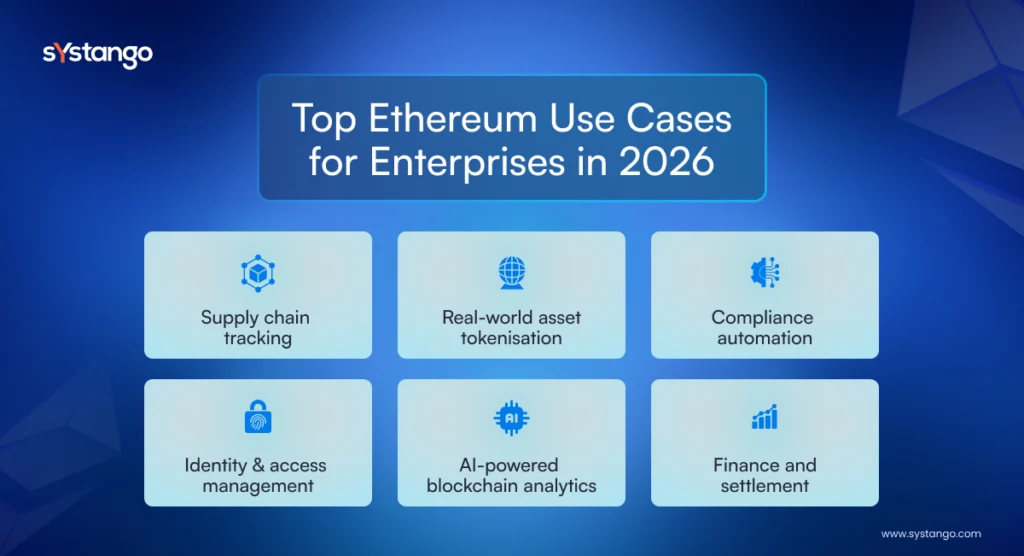
1. Supply Chain Transparency & Track-and-Trace
Every transaction is tamper-proof, which helps manufacturers, pharma companies, and logistics firms build trust and reduce fraud.
2. Finance & Tokenisation of Real-World Assets (RWA)
Ethereum leads in tokenising:
- Invoices
- Real estate
- Carbon credits
- Treasury assets
This unlocks liquidity and new revenue pathways.
3. Automated Compliance & Auditability
Smart contracts automate compliance steps and ensure audit trails remain immutable—all crucial for regulated industries.
4. Identity & Access Management
Decentralised identity (DID) systems help enterprises modernise authentication and reduce data theft.
5. AI-Enhanced Blockchain Analytics
With AI in blockchain analytics, businesses now detect anomalies, perform predictive compliance, and run behavioural risk scoring on-chain; capabilities impossible in earlier blockchain generations.
IV. Challenges Enterprises Still Face with Ethereum (2026 Outlook)
Even with rapid improvements, adoption challenges exist:
- Regulatory uncertainty
- High architectural complexity
- Need for enterprise governance
- Cost fluctuations during peak network usage
This is why enterprises partner with expert blockchain development services firms to design, scale and secure Ethereum applications.
V. Future of Ethereum for Business
2026is the year Ethereum moves from “innovation experiments” to enterprise-grade digital infrastructure.
Key trends include:
- AI-assisted contract generation
- Enterprise ready L2s
- Private-public hybrid Ethereum networks
- Growth in asset tokenisation adoption
The ethereum blockchain platform will remain foundational to enterprise Web3 roadmaps; especially as AI and automation continue reshaping digital transformation.
Strategic Summary
The Ethereum blockchain platform continues to anchor enterprise Web3 strategies because it combines programmable smart contracts, decentralised security, and scalable infrastructure through Layer-2 networks.
As organisations move beyond experimentation, Ethereum is increasingly being used to build tokenised asset platforms, automated compliance systems, supply chain transparency networks, and decentralised identity frameworks.
However, implementing enterprise blockchain requires specialised expertise in architecture, scalability, governance, and integration.
This is where Systango plays a critical role. By combining expertise in blockchain development, Layer-2 scaling, enterprise integrations, and AI-powered blockchain analytics, Systango helps organisations design and deploy secure Ethereum solutions that deliver measurable business outcomes.
From strategy and architecture to development and optimisation, Systango enables enterprises to transform Ethereum from a technology experiment into a scalable digital infrastructure for Web3 innovation.
Executive Summary
The Ethereum blockchain platform remains the foundation of enterprise Web3 adoption in 2026. With its Proof-of-Stake security model, powerful smart contract capabilities, and rapidly expanding Layer-2 ecosystem, Ethereum provides organisations with a scalable and secure platform for building decentralised applications and digital asset systems.
Enterprises across industries are leveraging Ethereum to implement tokenised financial assets, transparent supply chain networks, decentralised identity systems, and automated compliance frameworks. The integration of AI-driven blockchain analytics is further strengthening enterprise capabilities by enabling predictive monitoring, anomaly detection, and risk analysis.
While Ethereum offers significant strategic advantages, successful enterprise implementation requires thoughtful architecture, governance frameworks, and seamless system integration.
With expertise in enterprise blockchain development and Web3 architecture, Systango helps organisations build secure, scalable Ethereum solutions that unlock transparency, automation, and new digital business models.
Conclusion
The ethereum blockchain platform continues to lead enterprise Web3 adoption because it balances scalability, transparency, automation, and security better than any alternative. As businesses seek clarity on how does ethereum work 2026, they are discovering opportunities in transparency, tokenisation, AI-driven analytics, and decentralised automation.
Systango supports enterprises in building scalable, secure and future-ready Ethereum applications—from strategy to development to integration. With deep expertise in blockchain development services, Web3 protocols, L2 scaling, and enterprise AI, Systango helps businesses turn Ethereum into measurable ROI and competitive advantage.