

Enterprise AI-Powered DevOps in 2026: How Leaders Are Building Intelligent Delivery Platforms
Last Updated on: March 3, 2026
Shipping faster is no longer enough.
Shipping intelligently is the differentiator.
In 2026, DevOps success is measured not just by deployment speed, but by resilience, automation depth, security integration, and developer experience. Enterprises that treat DevOps as infrastructure strategy—not tooling—are outperforming competitors.
What’s Inside
III. Strategic Insight: Platform-Centric DevOps
IV. What Does Modern DevOps Look Like in Large Enterprises?
V. How Has AI Changed DevOps Since 2021?
VI. Which Companies Are Leading in DevOps Practices in 2026?
VII. Real-World Enterprise Proof
VIII. What Role Does Security Play in Modern DevOps?
IX. What Is GitOps and Why Are Companies Adopting It?
X. Implementation Roadmap for Intelligent DevOps
XI. DevOps KPIs That Define Success in 2026
XIV. Strategic Takeaways for Leaders
Key Takeaways
This guide explores how AI-powered DevOps (AIOps) and platform engineering are reshaping enterprise software delivery in 2026.
It covers:
- What modern DevOps looks like in large enterprises
- How AI has changed DevOps since 2021
- GitOps and DevSecOps integration
- DevOps for data engineering
- DevOps KPIs in 2026
- Real-world case study proof
Designed for CTOs and engineering leaders, this article outlines how to implement scalable, intelligent DevOps systems aligned to business performance.
I. Why DevOps Has Changed
Gartner projects that platform engineering will emerge as a key enabler for scalable digital delivery.
The shift is structural:
- From pipeline scripts
- To internal developer platforms
- From reactive monitoring
- To predictive AIOps
II. The Enterprise Challenge
Despite heavy DevOps tooling investment, many organisations struggle with:
- Tool sprawl and pipeline inconsistency
- Security gaps in CI/CD
- Alert fatigue from poor observability
- Slow MTTR
- Fragmented governance
Without unified platform engineering 2026, DevOps becomes complex and brittle.
III. Strategic Insight: Platform-Centric DevOps
Modern DevOps best practices 2026 revolve around three pillars:
1. Internal Developer Platforms
2. AI-powered DevOps (AIOps)
3. Security-by-design (DevSecOps)
Enterprises are moving beyond tool-centric pipelines toward managed platforms that abstract complexity and standardise governance.
IV. What Does Modern DevOps Look Like in Large Enterprises?
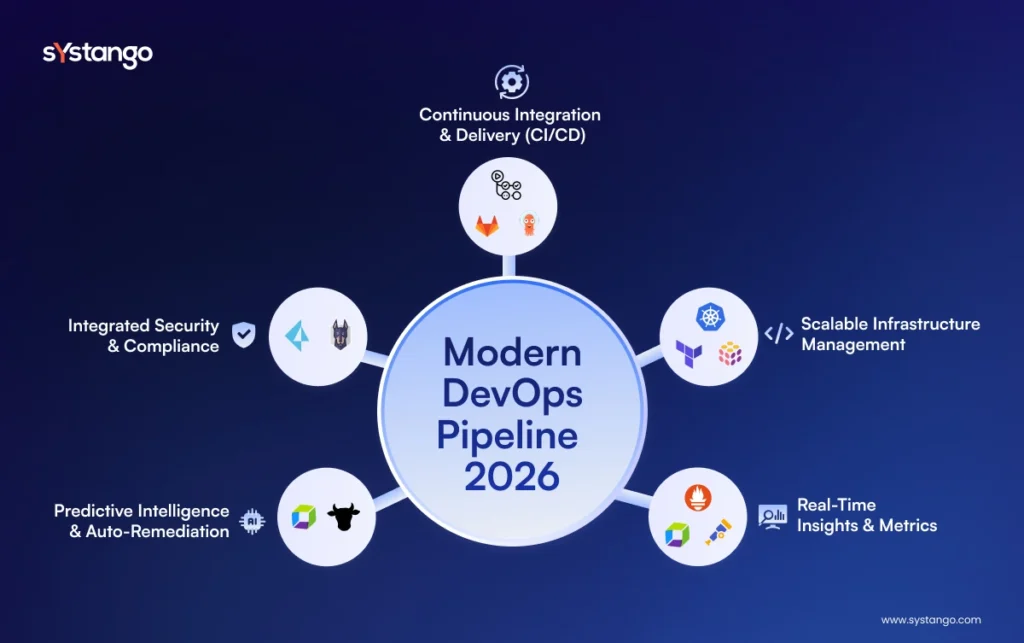
Large enterprises now implement:
- Shared internal developer platforms
- GitOps as a source-of-truth model
- Declarative infrastructure as code
- Intelligent observability layers
- AI-driven incident detection
This approach reduces cognitive load and improves deployment reliability.
V. How Has AI Changed DevOps Since 2021?
AI has introduced:
1. Intelligent Observability
Anomaly detection across logs, metrics, and traces before outages escalate.
2. Auto-Remediation
AI agents trigger rollbacks or configuration fixes.
3. Infrastructure Code Assistance
AI suggests Terraform, Kubernetes YAML, or Helm optimisations.
4. ChatOps
Engineers query deployments conversationally.
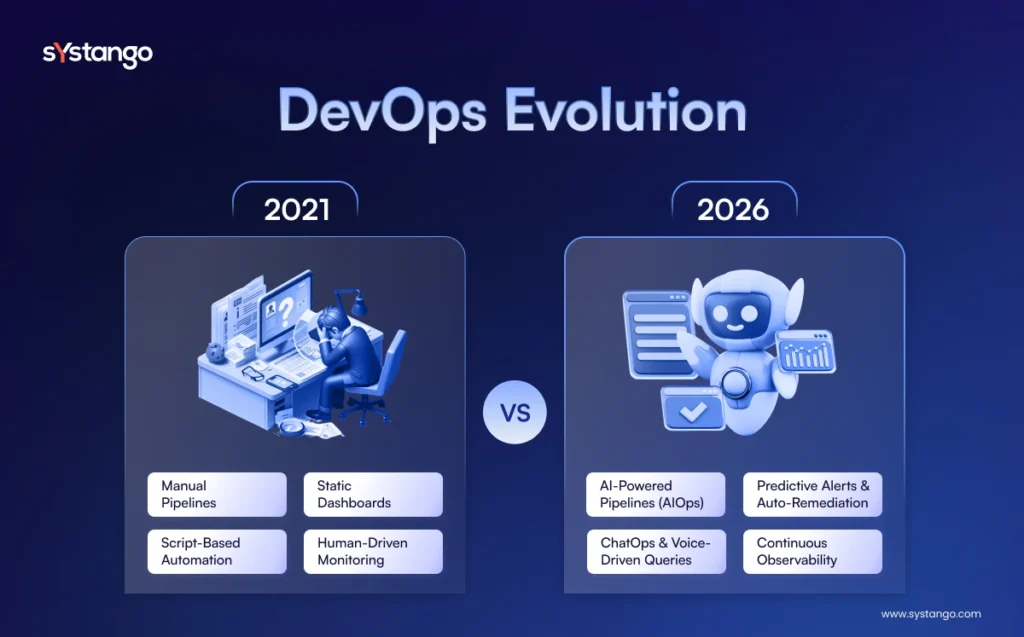
These capabilities define AI in DevOps maturity in 2026.
VI. Which Companies Are Leading in DevOps Practices in 2026?
Global examples include:
- Netflix (chaos engineering + automation)
- GitLab (end-to-end CI/CD security integration)
- Shopify (platform engineering model)
- Databricks (DevOps for data engineering integration)
These organisations prioritise automation depth, resilience, and developer autonomy.
As enterprises attempt to replicate these DevOps capabilities, many rely on engineering partners like Systango to design scalable CI/CD architectures, automate infrastructure, and implement modern DevOps frameworks across cloud environments.
VII. Real-World Enterprise Proof
While DevOps maturity is often associated with large technology companies, many enterprises across industries are now achieving similar outcomes through structured DevOps implementation and cloud engineering partnerships.
1. Cloud Infrastructure Optimisation & Scalability
A global queue management platform partnered with Systango to modernise infrastructure and implement DevOps transformation.
Outcomes:
- 80% reduction in hosting costs
- 4× scalability improvement
- 150+ global store deployments
- 99.9%+ system uptime
Full case study here.
2. AI-Enhanced Legal Workflow Automation
A legal enterprise implemented AI-integrated DevOps pipelines and workflow automation.
Results:
- 30% efficiency uplift
- 80% faster document turnaround
- 20% workforce load reduction
These outcomes demonstrate how structured DevOps consulting drives measurable business performance.
VIII. What Role Does Security Play in Modern DevOps?
DevSecOps is embedded:
- Shift-left scanning
- Policy-as-code (OPA)
- Runtime protection
- Automated rollback
- Audit-ready observability
Security is no longer a gate; it is part of pipeline architecture.
IX. What Is GitOps and Why Are Companies Adopting It?
GitOps treats Git as the single source of truth.
Benefits:
- Full audit trails
- Declarative infrastructure
- Automated drift correction
- Seamless integration with AIOps
GitOps is foundational to platform engineering and scalable governance.
X. Implementation Roadmap for Intelligent DevOps
Phase 1: Platform Assessment (Weeks 1–3)
Evaluate tool sprawl and deployment maturity.
Phase 2: Platform Engineering Design (Weeks 3–6)
Create internal developer platform blueprint.
Phase 3: AIOps Integration (Weeks 6–10)
Deploy observability + predictive remediation.
Phase 4: DevSecOps & GitOps Alignment (Months 3–6)
Embed governance, compliance, and automation loops.
This phased implementation roadmap helps reduce risk while improving operational performance and DevOps KPIs.
XI. DevOps KPIs That Define Success in 2026
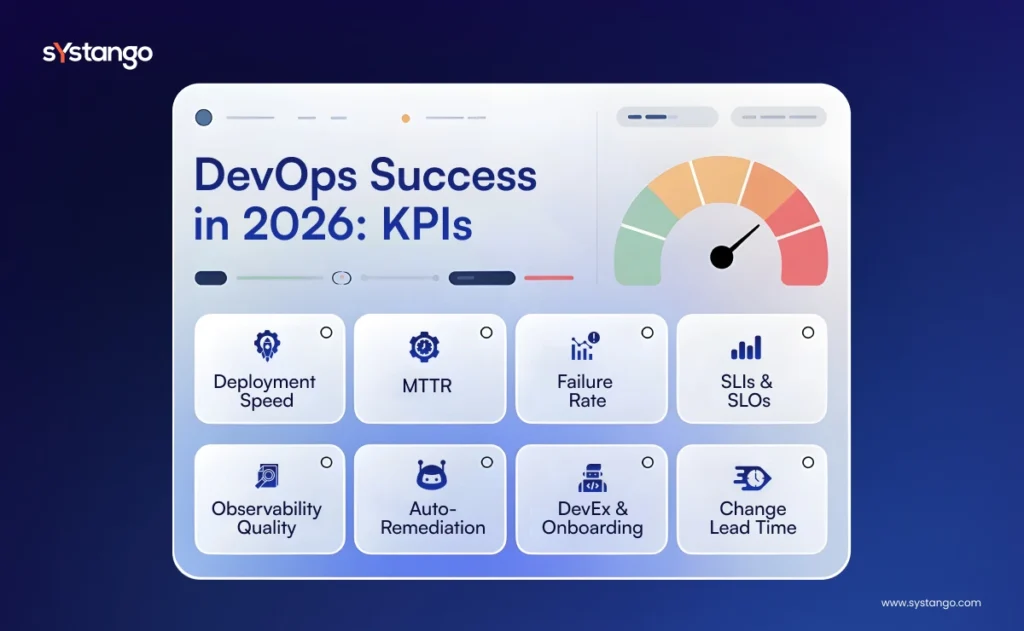
- Deployment Frequency
- Mean Time to Recovery (MTTR)
- Change Failure Rate
- SLO Compliance
- Automated Remediation Ratio
- Developer Experience (DevEx)
- Change Lead Time
These metrics determine DevOps maturity.
XII. Risk of Inaction
Without AI-powered DevOps:
- Deployment cycles slow
- Infrastructure costs rise
- Security gaps widen
- Developer burnout increases
- Incident recovery delays multiply
In 2026, intelligent pipelines are not optional—they are survival infrastructure.
XIII. Future Outlook
DevOps is evolving into:
- AI-orchestrated digital infrastructure
- Autonomous remediation pipelines
- Fully abstracted internal developer platforms
- Integrated DevOps for data engineering
The boundary between AI and DevOps will disappear.
XIV. Strategic Takeaways for Leaders
- Platform engineering is foundational to scale.
- AIOps reduces operational toil dramatically.
- DevSecOps is mandatory, not optional.
- GitOps enables governance and automation maturity.
- Structured DevOps as a service accelerates transformation.
Strategic Summary
In 2026, DevOps has evolved from CI/CD automation into intelligent platform orchestration. Enterprises adopting AI-powered DevOps (AIOps) integrate predictive observability, auto-remediation, GitOps governance, and DevSecOps into internal developer platforms. This shift reduces operational toil, accelerates releases, and improves system resilience.
Through structured DevOps consulting and DevOps as a service models, Systango helps organisations design cloud-native, AI-enabled pipelines that scale efficiently and deliver measurable ROI.
Conclusion
DevOps in 2026 is no longer about pipelines.
It is about intelligent, self-healing, platform-driven systems.
Enterprises adopting AI-powered DevOps (AIOps), GitOps governance, and platform engineering are achieving faster releases, lower costs, higher uptime, and stronger security posture.
Through structured DevOps consulting and DevOps as a service models, Systango helps organisations architect scalable, resilient, and AI-enabled software delivery ecosystems.
Executive Summary
DevOps in 2026 is defined by AI-powered DevOps (AIOps), platform engineering, GitOps governance, and DevSecOps integration. Enterprises are shifting from tool-centric pipelines to internal developer platforms that enable predictive observability, auto-remediation, and scalable automation. Real-world case studies demonstrate measurable outcomes including 80% infrastructure cost reduction, 4× scalability improvement, and 30% workflow efficiency uplift. With structured DevOps consulting and DevOps as a service models, organisations can implement intelligent, resilient pipelines that reduce risk, improve developer experience, and drive business agility. DevOps is no longer operational hygiene—it is competitive infrastructure.