


Rust vs C++ in 2026: How Enterprises Should Choose the Right Systems Architecture
Last Updated on: March 3, 2026
In 2026, programming language selection is no longer a developer preference.
It is an architectural risk decision.
When evaluating Rust vs C++ in 2026, leaders must move beyond benchmarks and consider:
- Memory vulnerability exposure
- Concurrency reliability
- Long-term maintenance cost
- Cloud-native readiness
- Talent sustainability
The wrong decision compounds technical debt.
The right one reduces operational risk for years.
What’s Inside
I. The Systems Programming Inflection Point
III. Rust vs C++ in 2026: Performance & Safety Comparison
IV. Rust vs C in Modern Software Development
V. Strategic Framework: How Enterprises Should Decide
VI. Decision Making: Rust vs C++
VII. Business Impact (ROI Perspective)
Key Takeaways
This guide examines Rust vs C++ in 2026, helping CTOs and technology leaders evaluate:
- Performance benchmarks
- Memory safety models
- Concurrency guarantees
- Ecosystem maturity
- Cloud-native and embedded system readiness
It provides a structured decision framework to align language selection with scalability, operational risk, and long-term maintainability.
I. The Systems Programming Inflection Point
Infrastructure complexity is increasing:
- Distributed microservices
- Edge computing
- AI-accelerated backends
- Blockchain infrastructure
- Real-time analytics platforms
According to the Stack Overflow Developer Survey, Rust remains one of the most admired programming languages globally, signalling strong developer momentum.
GitHub’s Octoverse report continues to highlight Rust as one of the fastest-growing languages, while C++ maintains deep enterprise penetration across performance-intensive systems.
Modern systems programming language trends indicate rising demand for memory safety and concurrency guarantees.
II. Enterprise Challenge
CTOs face three structural risks in 2026:
- Memory-related vulnerabilities leading to production failures
- Concurrency bugs causing unpredictable system behaviour
- Escalating long-term maintenance and refactoring costs
C++ provides deep control and optimisation but depends heavily on disciplined implementation.
Rust enforces memory safety through ownership and borrow checking at compile time — preventing entire classes of runtime errors.
This is not merely about syntax.
It is about operational risk tolerance.
III. Rust vs C++ in 2026: Performance & Safety Comparison
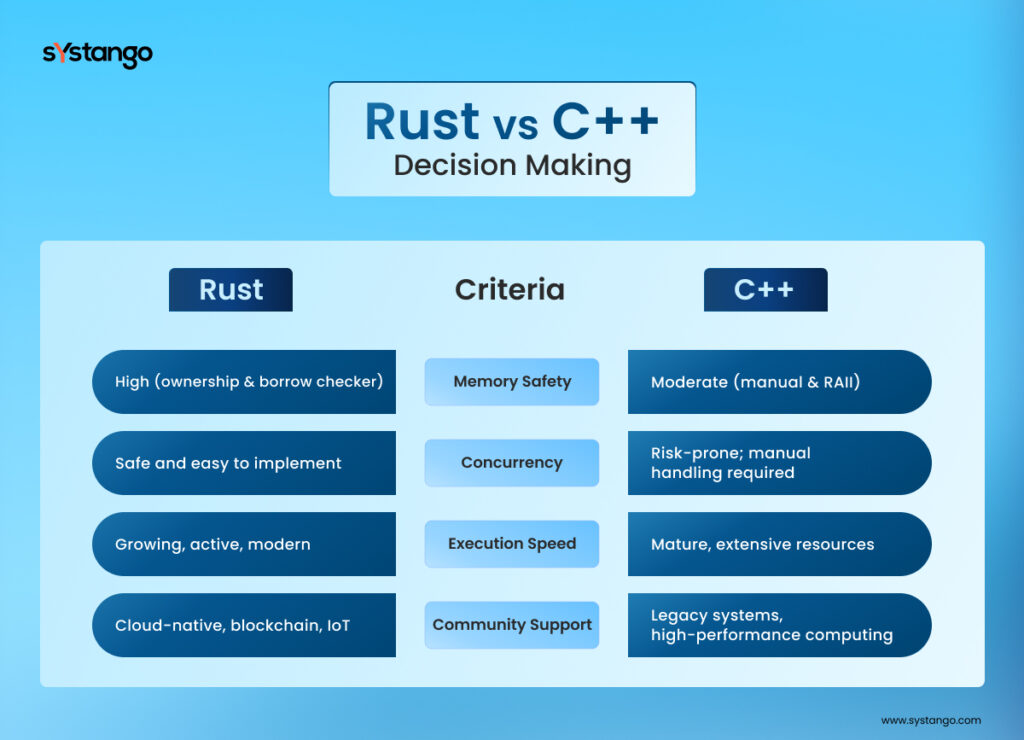
1. Memory Safety
Rust: Ownership & Borrow Checker
C++: Smart Pointers & RAII
Rust eliminates null pointers and data races at compile time.
C++ mitigates risk but requires manual enforcement.
2. Concurrency
Rust: Thread-safe by design
C++: Manual management required
Rust advantage in concurrent programming over C++ significantly reduces race-condition exposure.
3. Execution Speed
Modern Rust vs C++ performance benchmark 2026 comparisons show near parity across most systems-level workloads.
C++ retains advantages in specific hardware-optimised scenarios.
4. Community & Ecosystem
C++: Mature and extensive
Rust: Growing and modern
C++ dominates legacy environments. Rust adoption is accelerating in greenfield and distributed architectures.
IV. Rust vs C in Modern Software Development
The comparison extends further.
In Rust vs C in modern software development, the differentiation is clearer:
- Rust prevents undefined behaviour and buffer overflows
- Stronger safety in IoT and edge computing
- Reduced memory corruption risk
C remains foundational in embedded systems, but Rust is gaining enterprise traction where reliability is non-negotiable.
V. Strategic Framework: How Enterprises Should Decide
Language selection in 2026 should follow a structured evaluation model:
1. Risk Assessment
Analyse historical production incidents tied to memory or concurrency errors.
2. Architecture Alignment
Map language capabilities to cloud-native, distributed, or hardware-constrained systems.
3. Ecosystem & Talent Strategy
Evaluate internal expertise, hiring market maturity, and long-term maintainability.
4. Hybrid Viability
Assess whether a phased Rust adoption layered over existing C++ infrastructure reduces disruption risk.
This framework shifts the debate from “Which is better?” to “Which aligns with enterprise risk and growth strategy?”
VI. Decision Making: Rust vs C++
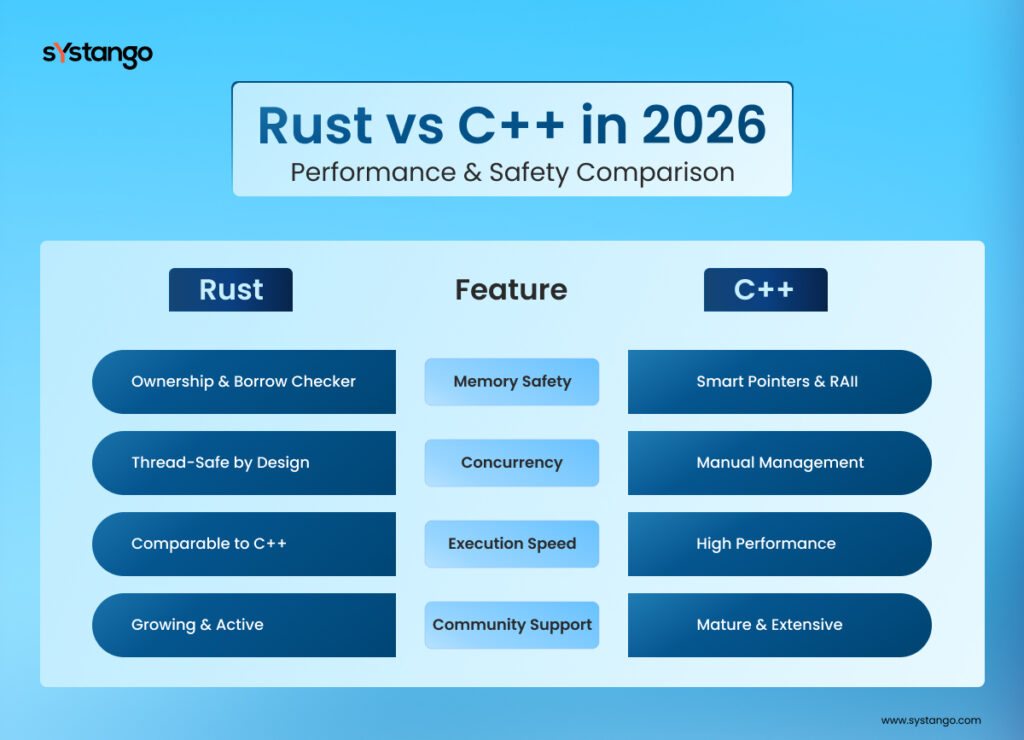
This decision matrix provides a board-ready comparison of strategic fit across:
- Safety
- Concurrency
- Ecosystem maturity
- Use case alignment
VII. Business Impact (ROI Perspective)
Language decisions directly affect financial outcomes.
1. Maintenance Cost
Rust’s compile-time guarantees reduce post-deployment bug remediation cycles.
2. Downtime Reduction
Memory-related production incidents decrease with enforced safety models.
3. Developer Productivity
Rust’s safety model improves long-term codebase maintainability, though onboarding may require structured upskilling.
4. Future Scalability
Rust aligns strongly with distributed architectures and concurrent workloads required in AI-driven and cloud-native systems.
Language strategy influences total cost of ownership over multi-year horizons.
VIII. Implementation Roadmap
Phase 1: Systems Audit
Identify concurrency hotspots and memory-risk modules.
Phase 2: Pilot Deployment
Introduce Rust in new services or isolated components.
Phase 3: Performance Validation
Run internal benchmarks comparing Rust vs C++ performance benchmark 2026 metrics within your own environment.
Phase 4: Hybrid Architecture Rollout
Maintain C++ for stable legacy layers while expanding Rust in new distributed systems.
Hybrid strategies mitigate disruption risk.
IX. Risk of Inaction
Delaying structured evaluation of Rust vs C++ in 2026 leads to:
- Accumulating technical debt
- Increased security exposure
- Slower cloud-native transformation
- Higher refactoring cost later
Strategic hesitation compounds operational risk.
X. Future Outlook (2026–2028)
Key trends shaping systems programming:
- Stronger emphasis on memory safety models
- Increased concurrency demands in distributed systems
- AI-assisted development tools influencing language productivity
As AI accelerates code generation, compile-time safety guarantees become more valuable to prevent systemic error propagation.
Architecture resilience will define sustainable software development.
XI. Strategic Takeaways
- Rust prioritises enforced safety and concurrency guarantees.
- C++ remains dominant in performance-intensive and legacy domains.
- Hybrid adoption reduces transition risk.
- Language decisions affect operational resilience and scalability.
- CTOs must align systems programming choices with long-term architecture strategy.
Strategic Summary
The debate around Rust vs C++ in 2026 reflects a structural shift in modern systems programming. C++ continues to power performance-critical and legacy systems, while Rust’s compile-time memory safety and concurrency guarantees are reshaping cloud-native, blockchain, and distributed architectures. For enterprises, this decision influences risk exposure, maintenance cost, hiring strategy, and architectural resilience.
At Systango, we help enterprises evaluate language strategy through an architecture-first lens — aligning performance goals with long-term scalability and operational stability.
Conclusion
The debate around Rust vs C++ in 2026 is not about superiority.
It is about alignment.
Rust offers safety-first architecture and concurrency reliability.
C++ provides proven performance and ecosystem maturity.
The right decision depends on infrastructure roadmap, performance demands, and enterprise risk appetite.
Executive Summary
In 2026, choosing between Rust and C++ is a strategic architecture decision. Rust delivers enforced memory safety, safe concurrency, and strong momentum in cloud-native and distributed systems. C++ continues to power embedded, graphics-intensive, and performance-critical applications with deep ecosystem maturity. Modern performance benchmarks show comparable runtime efficiency, shifting enterprise focus toward risk mitigation, maintainability, and long-term scalability. A structured, hybrid adoption strategy often provides the optimal balance between innovation and stability. Enterprises that evaluate language choice through an architecture-first lens reduce future refactoring cost and operational exposure.